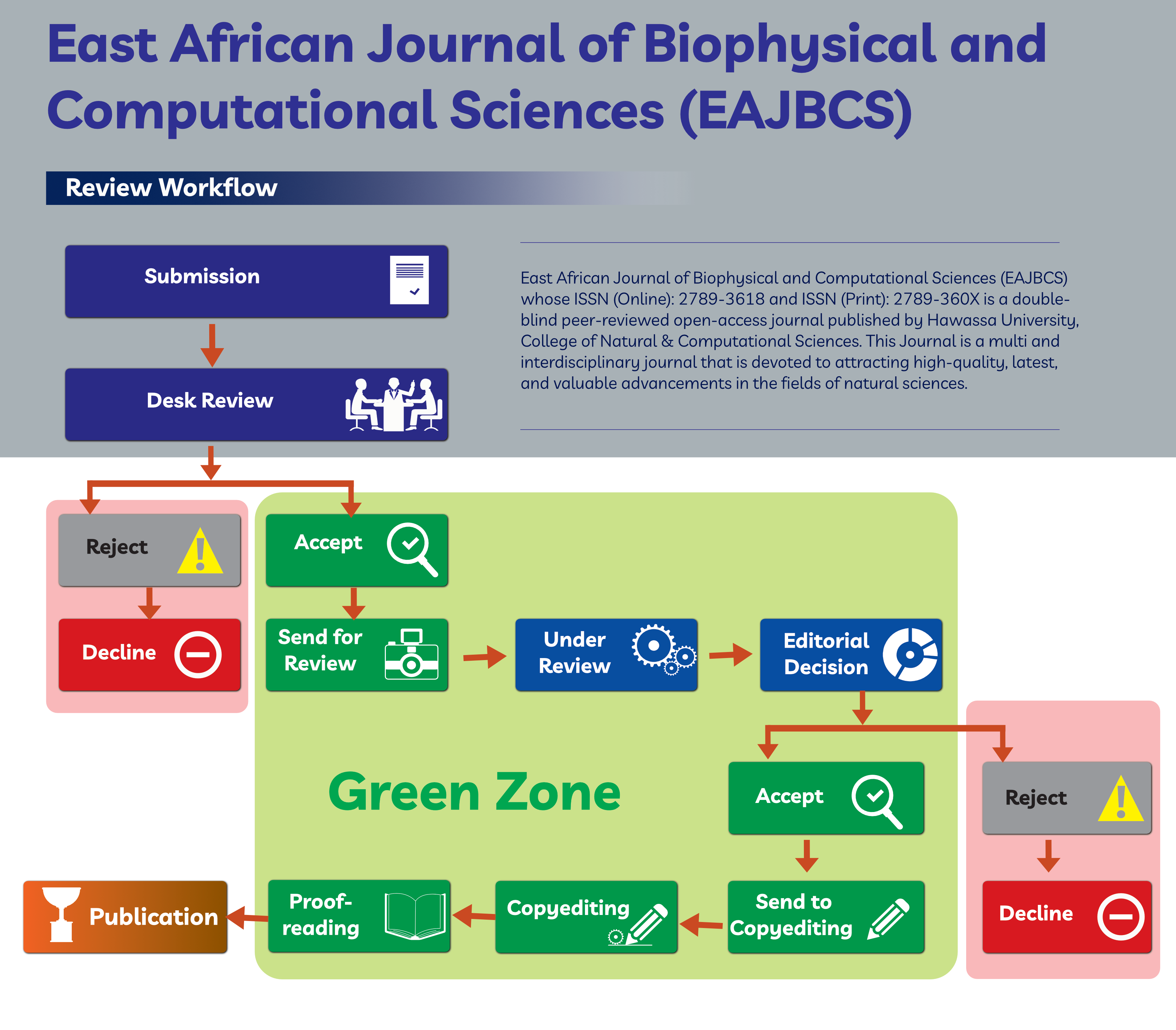
Review Process
Early Editorial stage
Upon submission to East African Journal of Biophysical and Computational Sciences (EAJBCS), manuscripts shall undergo the following rigorous review procedures:
- The Editor-in-Chief acknowledges the receipt of a manuscript and assigns it to the appropriate Associate Editor within one week;
All submitted manuscripts pass through preliminary assessment by the Editor-in-Chief. Only manuscripts that meet the Editorial criteria are sent to peer-review. Manuscripts judged by the editors as being inappropriate, plagiarized (similarity above 20%), or below the journal's standard are rejected promptly without peer-review. These decisions are based on the preliminary assessors’ reports and acceptance of the Editorial Board.
- The Editorial Board shall make one of the three decisions: ‘accept manuscripts for external review’ or ‘return it to the author for revision’ or ‘reject it’;
- The Editorial Board also determines whether a manuscript is to be accepted as an original full-length article, brief communication, case report, or review article;
- Once accepted for external review, the Associate Editor in the relevant discipline identifies potential reviewers with appropriate specialty or expertise and typically sends the manuscript to two reviewers, although additional reviewers may be invited if specialization advise is needed (for example, on new statistical methods or a particular technique). To facilitate the review process review form or guideline shall be provided, which reviewers are expected to fill and return along with reviewed manuscript. Download the Manuscript Review Form here. Reviewers will be requested to complete and return their evaluation within four weeks of receiving the manuscript. Reviewers shall report their recommendations to the Associate Editor based on the the following categories:
- ‘Accept as it is’,
- ‘Accept with minor revision’,
- ‘Accept with major revision’,
- ‘Reject and resubmit’,
- ‘Reject’
- Based on the reviewers’ comments and recommendations , the Editorial Board shall make a final decision.
Editorial Board decisions should not be based solely on counting votes and does not always follow the majority recommendation. Rather, the Board should evaluate the strength of arguments presented by the author(s) and each reviewer, may also consider other information not available to either party. The editors’ primary responsibilities are serving their readers and the scientific community. In determining how best to fulfill these responsibilities, the Editorial Board must also weigh the merits of each manuscript. Moreover, the Editorial Board will evaluate the submitted manuscript based on the originality and significance of its contribution to the existing scientific literature. If a manuscript is accepted with modifications, it will be returned to the author(s) by the Associate Editor for revision (within one week of receiving the reviewers comments).
- Rejected manuscripts will be returned to the corresponding author by the Associate Editor/Editor-in-Chief.
- Manuscripts accepted with 'minor revisions' should be revised promptly by the authors to the satisfaction of the reviewers and the Editorial Board;
- Manuscripts accepted with ‘major revision’ and revised by authors should be resubmitted to the Associate Editor within two weeks. They will be returned to original reviewers to verify the proper incorporation of comments, preferably within one week. If approved by the reviewers and the Editorial Board, the manuscript shall be accepted for publication;
- A maximum of one week will be allowed for author(s) to incorporate comments related to ‘Minor revision’. The manuscript shall then be accepted for publication.
- A maximum of two weeks will be allowed for author(s) to incorporate comments related to ‘Major revision’. The decision on the revised manuscript will be made based on the level of reviewers and Associate Editors satisfaction. In case if an additional review process is necessary, the manuscript may be resent to the reviewers.
- Authors should re-submit the revised manuscript and a separate file detailing their responses to each comment provided by reviewers and Associate Editor.
- During the review process the authors' and reviewer's anonymity is preserved, as the Journal follows a double-blind process;
- Manuscripts accepted by both reviewers with or without minor editorial revisions shall be edited by the Associate Editor and then presented to the Editor-in-Chief for final approval;
- If a manuscript is rejected by one of the reviewers but accepted (with minor or major revision) by the other, the final decision shall be made by the Editorial Board.
Editors may return manuscripts to reviewers for further advice, particularly in cases where they disagree with each other or where the authors believe they have been misunderstood on points of facts. In such cases, the Board should ask the reviewers whether they are willing to provide the requested follow-up advice. Editors should be aware, that reviewers are often reluctant to be drawn into prolonged disputes, therefore, consultation should be kept to the minimum judgment necessary to ensure a fair hearing for the authors. When reviewers agree to assess a manuscript, the Board should consider this as a commitment to reviewing subsequent revisions. However, a resubmitted manuscript will not be sent back to the reviewers if authors have not made a serious attempt to address the reviewers comments.
The Editorial Board takes reviewers’ comments and is particularly reluctant to disregard technical concerns. In cases where one reviewer opposes manuscript publication, editors may consult the other reviewer to assess whether the opposing reviewer is applying an unfair critical standard. Otherwise, the manuscript may be sent to third reviewer to resolve disputes and/or make the final decision on acceptance, however, editors should avoid doing so unless there is a specific issue, such as technical matter requiring further expert advice.
- A manuscript rejected by two reviewers shall be formally rejected, and the corresponding author shall be notified by the Editor-in-Chief.
- Delays in returning corrected proofs within the specified period may result in the paper being postponed to the next issue. At this stage, corrections must be limited to essential and editorial errors only.
Estimated Timeline for the Editorial Process of East African Journal of Biophysical and Computational Sciences (EAJBCS)
|
No |
Activities |
Estimated time |
Implementing agents |
|
1 |
Preliminary assessment |
One week |
Editorial Board |
|
2. |
Reviewing |
Four weeks |
Reviewers |
|
4 |
Revision |
One to two weeks |
Author(s) |
|
5 |
Verification |
One week |
Board members |
|
6 |
Reincorporation |
Two to three weeks |
Author(s) |
|
7 |
Language & layout edition |
Three to four weeks |
Language editor(s) |
|
8 |
Technical edition |
One to two weeks |
Technical editors |
The time from submission to publication is expected to be a maximum of six months. However, some articles may take longer time while others may take less time. Therefore, the editorial decision and reviewers’ comments should be timely communicated to the author. The final decision is then made within a week of receiving the revised manuscript. After the Board’s approval, the language and content editing should be completed within two to three weeks. subsequently, technical and layout editing is carried out within four to six weeks.
You can download the Review Process by clicking on this link.