
About the Journal

Aim and Scope
Ethiopian Journal of Engineering and Technology (EJET) ISSN: 3135-9779 is a nationally accredited, open-access, peer-reviewed journal that publishes articles advancing research in all fields of engineering and technology. Authors are invited to contribute by submitting articles that illustrate research findings, projects, survey work, and industrial experiences demonstrating major achievements in the field.
Journal Particulars
| Frequency of Publication | : Annual (January - December) |
| Publication Format | : Online |
| Language | : English |
| Starting Year | : 2021 |
| DOI | : https://doi.org/10.82127/ejet |
| License | : CC BY 4.0 |
| Copyright Statement | : Copyright © 2025; The Author(s) |
| ISSN (Online) | : 3135-9779 |
Subject Areas
The subject areas covered by EJET include (but are not limited to):
- Aerospace Engineering
- Automobile Engineering
- Applied Mathematics
- Applied Physics
- Bioinformatics
- Biophysics
- Biotechnology
- Chemical Engineering
- Chemical Physics
- Civil Engineering
- Communication Engineering
- Computational Physics
- Computer Engineering
- Electrical Engineering
- Electronic Engineering
- Energy Engineering
- Engineering Sciences
- Environment Engineering
- Health and Medical Informatics
- Human-centric and Pervasive Computing
- Information Technology
- Intelligent Robotics and Autonomous Agents
- Internet of Things
- Marine Engineering
- Materials Engineering
- Mechanical Engineering
- Medical Engineering
- Medical Imaging
- Medical Physics
- Nanotechnology
- Ocean Engineering
- Optical Engineering
- Photonics
- Robotics
- Urban Engineering
- Water Resource Engineering
- Waste Water Treatment
- Water Technology
Current Issue
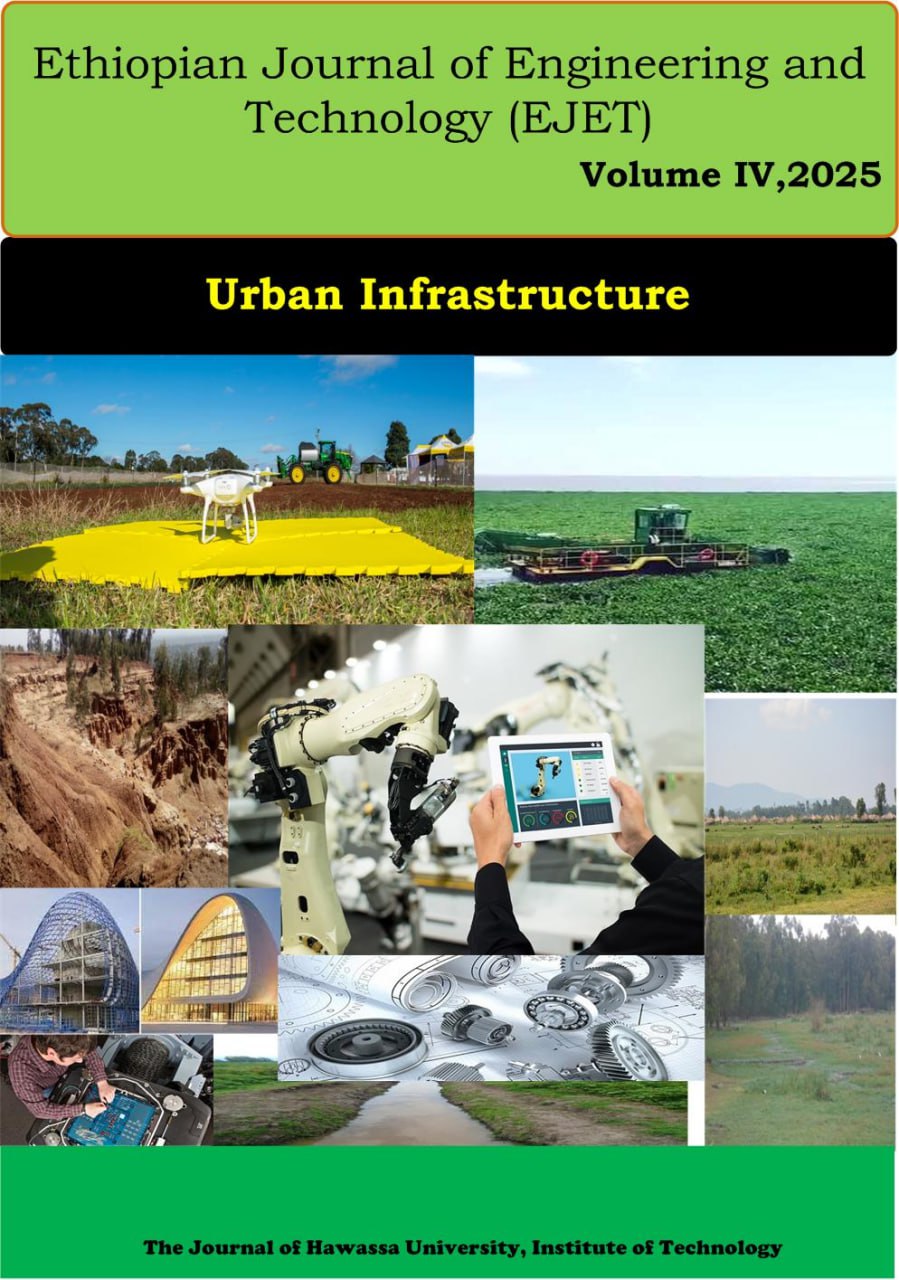
The current issue addresses a diverse range of topics relevant to urban infrastructure in both global and Ethiopian contexts. It includes the investigation of machine learning models for foodborne disease classification, shedding light on health and safety within urban environments. Business failure and the organizational capacity of contractors in Ethiopia are explored, highlighting the critical role of institutional strength in infrastructure development. A GIS-based analysis of land use and land cover change dynamics in the Boricha Catchment of the Central Main Rift Valley Lakes Basin of Ethiopia provides insights into environmental management and urban expansion. The effects of green supply chain practices on the environmental sustainability of Ethiopian small and medium-scale garment manufacturers are examined, connecting industrial growth with ecological responsibility. Further, the issue discusses Building Information Modeling (BIM) education and training in Ethiopia, emphasizing its significance in modern construction practices. "The Urban Paradox: Navigating Social Challenges and Building Resilience in the Heart of Cities" offers a deep dive into the socio-economic dynamics in selected cities of the Southern Corridors of Ethiopia. Conservation and restoration practices for historical buildings in Arada Sub-City, Addis Ababa, are investigated, demonstrating the importance of cultural heritage in urban planning. The stress analysis and optimization of critical components in plunger pumps illustrate advancements in mechanical systems vital to urban services. Finally, the issue presents perceptions of households towards urban waste management challenges, drawing evidence from the Southern Ethiopia Urban Corridor and underscoring the role of public engagement in sustainable urban living.
Articles

National Academic Accreditation
This journal is nationally accredited. Ethiopian Journal of Engineering and Technology has officially fulfilled the stringent quality evaluation criteria and academic publishing standards established by the Ministry of Education (MoE) of Ethiopia. The journal is recognized as an approved repository for high-impact scientific research and institutional career advancement metrics.


